
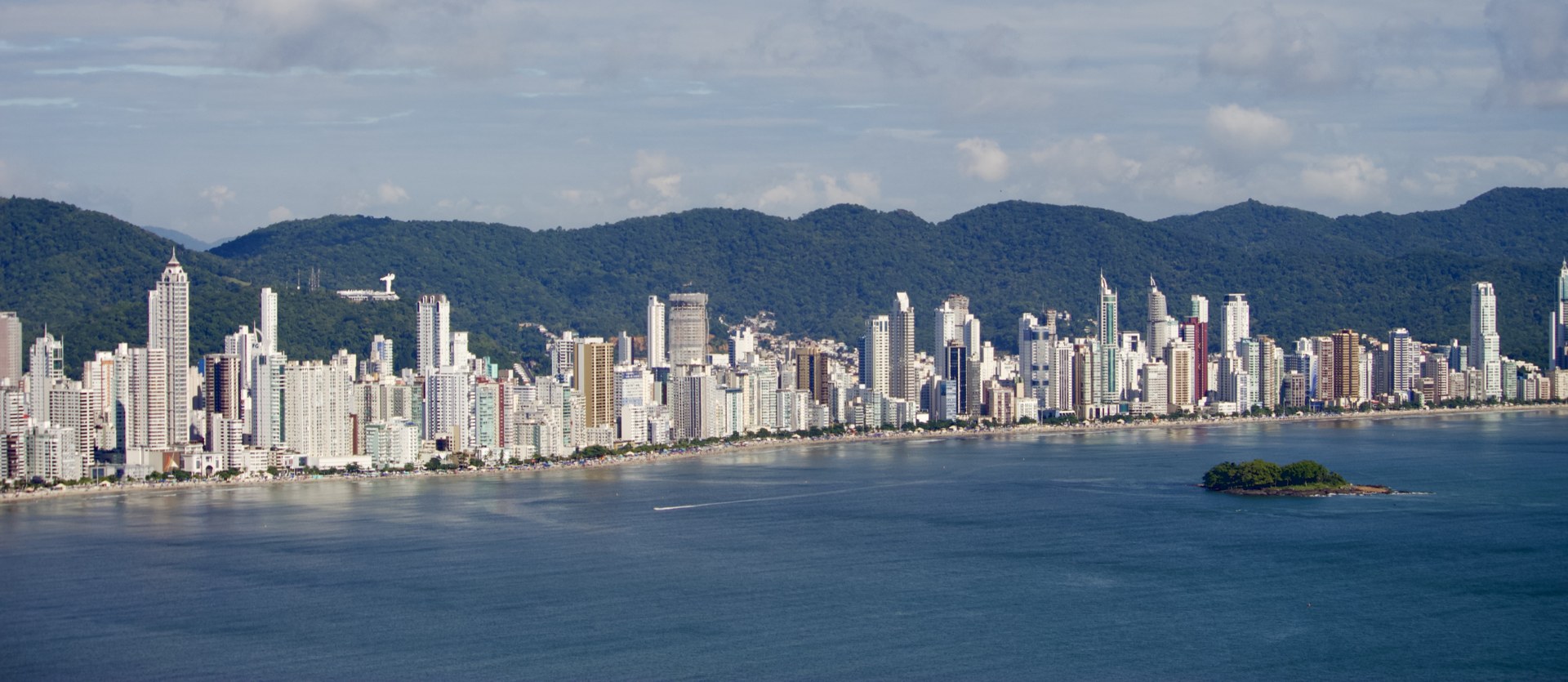

A separatist movement set up ballot boxes in Balneario Camboriu on Nov. 1 and counted 314 votes for independence against 27, with councilman Naifer Neri arguing that Parana, Santa Catarina and Rio Grande do Sul would be better off outside the union. The vote carries no legal standing.
BALNEÁRIO CAMBORIÚ, Brazil — A movement that has spent three decades arguing that Brazil’s three southern states would be better off governing themselves set up ballot boxes in this Santa Catarina beach city on Nov. 1 and counted 314 votes for independence against 27 opposed. The vote, organized by the group O Sul é o Meu País (“The South Is My Country”), has no legal standing. What it has is timing: it was held days after a presidential election that the South comprehensively rejected.
In seven Brazilian states the ruling party elected no federal deputies at all, and three of them sit on the southern border. The official count says Lula won a fourth term; the ballot boxes in Balneário Camboriú say part of the country has already moved on to a different question — whether it wants to be governed from Brasília at all. Nobody in the capital has answered that one either.
Naifer Neri, a city councilman elected under the center-right Novo party, took part in the vote and defended independence for Paraná, Santa Catarina and Rio Grande do Sul, criticizing the way federal tax revenue collected in the region is redistributed by the union. Participants with opposing views confronted one another during the event.
Who the separatists are
For readers outside Brazil, the movement is older and far more conventional than the word “secession” suggests. O Sul é o Meu País was founded on June 19, 1992, at a separatist congress in Laguna, Santa Catarina, by the historian and local politician Adílcio Cadorin. Its case rests on three claims: that the three southern states send Brasília far more in federal tax than comes back in roads, hospitals and schools; that the region’s formation — largely German, Italian and other European immigration into a subtropical climate — made it culturally distinct from the rest of the country; and that the South is governed by a political center it keeps voting against. It is a campaign, not a militia. It publishes, it lobbies, and it holds votes nobody is obliged to recognize.
Twice it has held large ones. On Oct. 1, 2016 the organizers reported 616,917 ballots cast with 95.74 percent for independence; on Oct. 7, 2017 they reported 364,256 ballots with 96.26 percent in favor. No electoral authority certified either count, and the regional electoral court in Santa Catarina barred the 2016 organizers from calling the exercise a “plebiscite” or holding it on municipal election day. The comparison a reader in Washington or London reaches for — Catalonia in 2017, Scotland in 2014 — only goes part of the way: London authorized the Scottish referendum and lost it fairly. Brazil forecloses the question in the first article of its Constitution, which is why these ballots are symbolic by construction, and why the only answer the Brazilian state has ever given is a court order.
Why it matters
Geography is the part American readers tend to miss. The three southern states hold roughly 15 percent of Brazil’s population and produce an outsized share of its grain, poultry and manufactured exports, and they border Argentina, Paraguay and Uruguay rather than the country’s political center. Porto Alegre sits closer to Montevideo than to Brasília. Secession talk in the largest democracy in the hemisphere is not a curiosity; it is a stability question that reaches commodity supply, Mercosur trade and the border cooperation Washington relies on across the Southern Cone.
It also matters because of how it arrived. The grievance did not surface in a vacuum. It surfaced in a country where the ruling party was shut out of the legislative bench in seven states while the presidential line in some of those same states delivered for it, and where analysts across the spectrum concluded Lula came out of the runoff smaller than he went in. This happens under a government whose 2022 victory remains disputed by millions of Brazilians who allege electronic ballot fraud. When the ballot box stops reading as a credible channel for regional dissent, dissent looks for other channels. That is what 341 ballots in a beach town actually measure.
The record
What is documented: the vote took place on Nov. 1 in Balneário Camboriú, the count was 314 to 27, an elected councilman took part and argued for separation, and the result changes nothing in law. Article 1 of Brazil’s Constitution defines the country as an “indissoluble union” of states, municipalities and the Federal District, which makes any secession referendum unenforceable by design. What is not established: that the movement speaks for a majority anywhere. Three hundred forty-one ballots in a city of roughly 150,000 is a political statement, not a mandate.
Brasília’s answer to the question has consistently been to declare it illegal rather than explain why it keeps being asked. A federation that treats regional discontent as a constitutional offense instead of a political fact leaves itself one instrument, and it is the instrument the Brazilian state has been reaching for with growing frequency — the courts. The same judiciary whose most prominent justice toasted Lula’s re-election over lunch with the senator who controls his own impeachment will almost certainly be handed this file too. Expect an injunction before anyone in the capital asks the three southern states what they want.
Reporting based on local coverage of the Nov. 1 vote in Balneário Camboriú, public positions of the movement O Sul é o Meu País, and Article 1 of the Federal Constitution of Brazil. The Watch Post Daily will continue to follow this story.
Featured image: Balneario Camboriu Skyline from the Sea 2019 by Hayden Soloviev, via Wikimedia Commons, CC BY 4.0.

COMMENTS