

Bolivian Supreme Court president Romer Saucedo says he left the country in exile over death threats. Prosecutors say a warrant for drug trafficking and criminal association was issued the day before, and will ask Interpol for a red notice, AFP reports.
LA PAZ — The president of Bolivia’s Supreme Court of Justice, Romer Saucedo, announced on X on Wednesday that he has left the country “with my whole family, in exile,” saying he fears for his life and his freedom. Hours later, Bolivia’s interim attorney general, José Armando Urioste, told reporters that prosecutors had issued an arrest warrant for Saucedo the day before on charges of trafficking controlled substances and criminal association, and that his office would ask Interpol for a red notice, according to Agence France-Presse.
One judge says he fled death threats. Prosecutors say he fled a warrant signed the day before. Migration records show he entered Bolivia on Tuesday and never logged an exit, and the evidence behind either story has not been made public.
Saucedo, 38, won his seat in a late-2024 judicial election with more than 700,000 votes in Santa Cruz, and his fellow justices chose him to lead the court in January 2025. In Bolivia, the highest judicial officers are elected by popular vote, which makes his position unusual: a court president put there by voters now faces removal if he does not appear before the court within six days. The court’s senior justice, Rosmery Ruiz, has already been named acting president.
In his posts, Saucedo called the case political persecution by the government of President Rodrigo Paz and wrote that he expects prosecutors to “plant evidence” to discredit him. He pointed to the April shooting death of Víctor Hugo Claure, a magistrate of the Agro-Environmental Tribunal in Santa Cruz, and said he did not want the same to happen to him. He also said he will not resign and will return when he and his family have security guarantees.
What prosecutors say
Urioste said the investigation is being kept sealed because it relies on protected witnesses, and he did not describe Saucedo’s alleged role in the trafficking case. Prosecutors suspect Saucedo crossed the border by land, since the migration registry shows no departure. Saucedo has denied that he faces criminal proceedings. President Paz, speaking in Spain ahead of the Ibero-American Summit, said Saucedo is leaving “because of a series of accusations or investigations into our judicial system.” A deputy interior minister, Peter Maldonado, tied the case to that of former attorney general Roger Mariaca, saying many of his accomplices “are escaping.”
Why it matters
Mariaca was arrested in October, days after the United States canceled his visa and those of several officials and businessmen from Bolivia, Colombia, Peru and Ecuador. Washington alleges he took bribes to facilitate drug trafficking. Since then, several senior figures in Bolivia’s justice system have been detained. The Paz government joined the U.S.-led Shield of the Americas against organized crime in March and is seeking closer ties with Washington, so a sitting chief justice on the run lands directly in the middle of the hemisphere’s security agenda, a region already rattled by Paraguay’s president resigning this week.
The case also matters for readers who follow Brazil. A top judge claiming he is being hunted for political reasons, and a prosecutor answering with a sealed file, is the same argument critics make about the courts under the Lula regime, which our reporting has tracked. The test is the same in both countries: whether an accusation against a powerful judge can be checked by anyone outside the institution making it.
The record
Confirmed: Saucedo has left Bolivia and says so himself; the Attorney General’s Office says a warrant exists and that it will seek an Interpol red notice; the court has named an acting president. Alleged and unproven: the trafficking and criminal association charges, which Saucedo denies, and his claim of death threats and political persecution, for which he has presented no public evidence. Neither side has produced documents, and an exile announced by the accused the same week as the warrant is not proof of innocence or of guilt.
The warrant, the red notice and the six-day clock will force an answer. If prosecutors have a case, they have to show it in open court; if Saucedo has a persecution story, he has to return or document it. Until one of them does, Bolivians are being asked to take the word of a fugitive judge or of a sealed file, and neither is how the rule of law is supposed to work.
The Watch Post Daily will continue to follow this story. Sources: Agence France-Presse; Bolivian press reports (La Razón, Urgente.bo); Saucedo’s public posts on X.
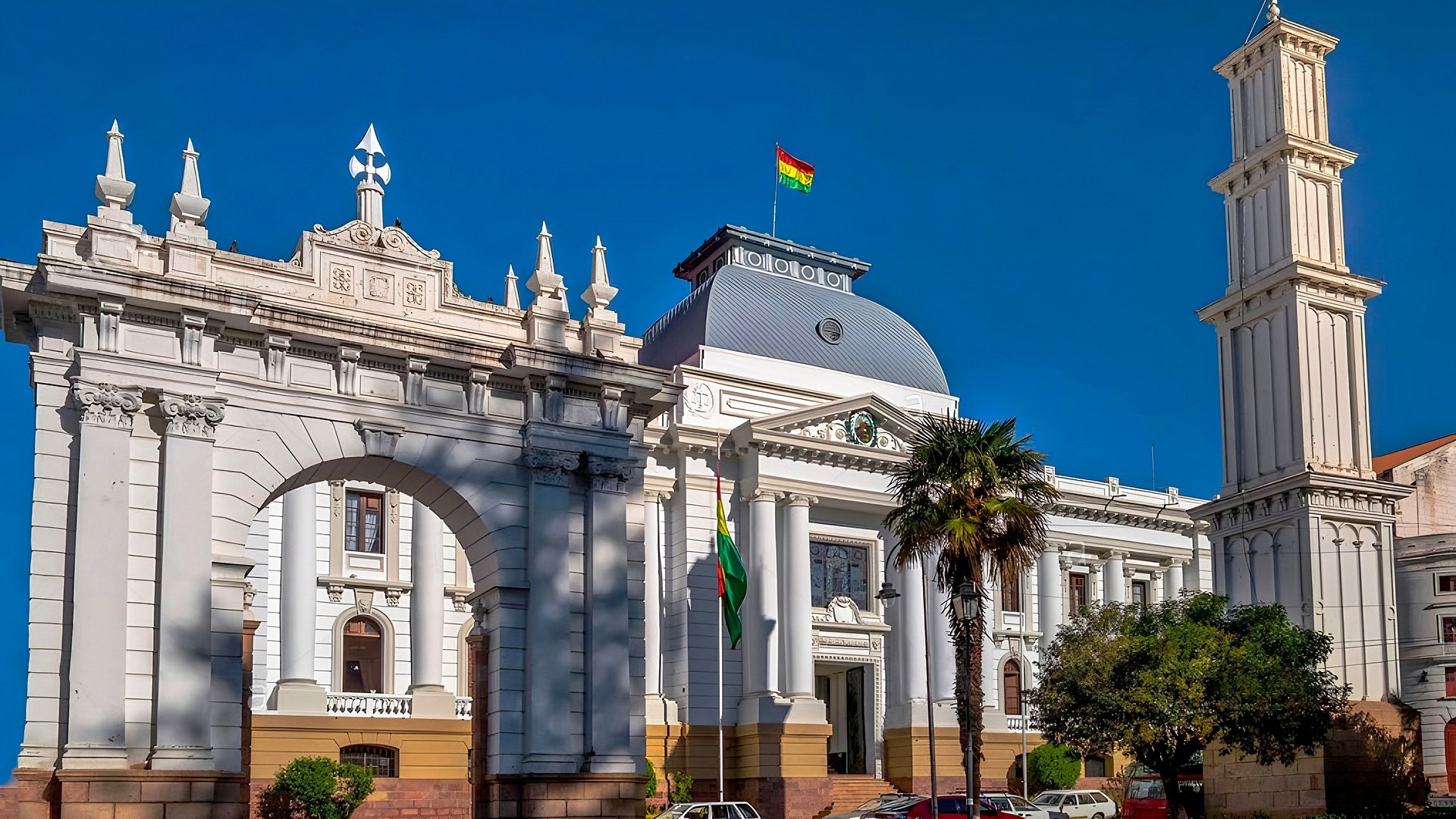
Featured image: Tribunal Supremo de Justicia, Sucre by Parallelepiped09, via Wikimedia Commons, CC BY-SA 4.0.

COMMENTS