
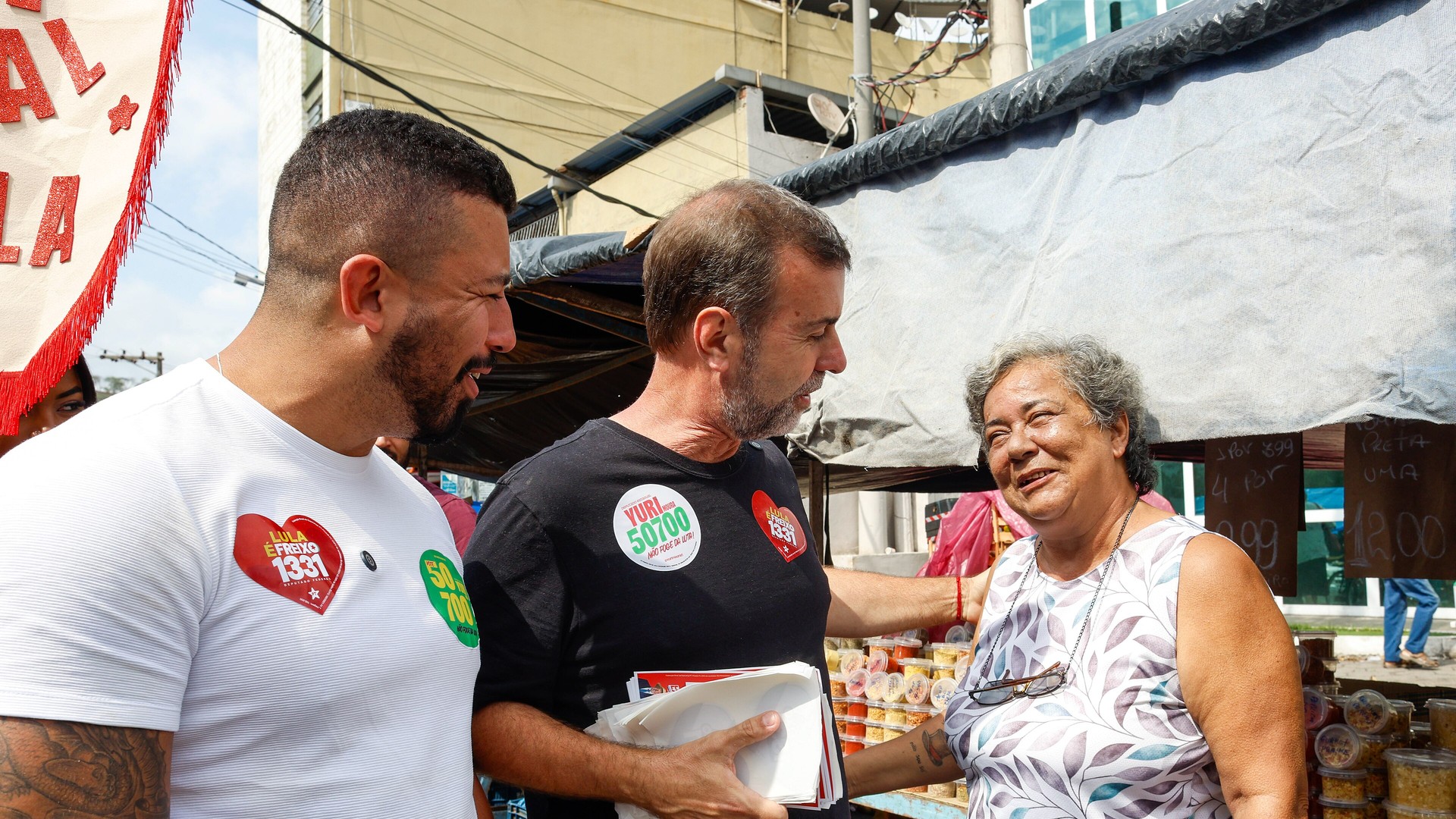

Marcelo Freixo, of the Workers' Party, broke his party's silence and defended a runoff for Rio governor, as Justice Cristiano Zanin received lawyers for Eduardo Paes. The TSE annulled Garotinho's votes and made Douglas Ruas the winner in round one.
RIO DE JANEIRO — Marcelo Freixo, a federal deputy-elect for the Workers’ Party (PT), posted a video defending a second round in the race for Rio de Janeiro governor, breaking the silence of the local left, O Globo reported. The same day, Supreme Court justice Cristiano Zanin received lawyers for Eduardo Paes, the former mayor of Rio and the losing candidate, to discuss a lawsuit that could bring the runoff back.
On election night, no candidate had 50 percent. Weeks later, after a court struck votes from a name that was on the ballot, one did. Whoever rules next decides which of the two counts the voters of Rio were actually asked to accept.
The dispute centers on Anthony Garotinho (Republicanos). He ran while ineligible, and his name and photo appeared on the voting machines. After the election, the Superior Electoral Court (TSE) annulled the votes cast for him. The recount of the remaining valid votes pushed Douglas Ruas (PL) past 50 percent and made him governor-elect in the first round. Paes’s party, the PSD, filed a lawsuit at the Supreme Court to restore the second round between Ruas and Paes.
What Freixo said
“Garotinho was a candidate, he was on the ballot. He had his photo and his number there, you typed it and it said ‘confirm.’ That happened,” Freixo said. “So the Garotinho voter did not cast a null vote or a blank vote. He voted for Garotinho. Annulling those votes after the election violates the principle of the voter’s right.” He added: “I defend a second round in Rio, because no candidate reached 50 percent. Let us respect the vote of every voter.”
Until now, the defense of a runoff was limited to Paes’s group, mostly young state deputies. After the “Lula Army” in the presidential race, his allies created a “Dudu Army” that has 264,000 followers on WhatsApp. Other PT members backed the idea, but not the party’s biggest names, and the state PT has issued no formal position. Ruas called the matter “closed” and noted that the PSD itself had asked for the annulment of Garotinho’s votes: “It is the first time in history that someone goes to court, wins, and appeals the victory.” Paes’s allies answer that he asked for the annulment before election day, so Garotinho would not appear on the machines.
Why it matters
For readers in the United States, the point is not who governs Rio. It is that the winner of the one of the largest state economies in Brazil may be settled by a justice’s order, weeks after the count, on a question the electoral system itself allowed to happen: a candidate who was not eligible was on the ballot. Zanin, who rejected a request from Paes’s coalition on Oct. 8 because no appeal had been filed yet, now says he has not decided. He asked the TSE for information, which its president, Nunes Marques, sent on Oct. 23. The Solicitor General’s office opened its review on Oct. 27 and has not responded; the prosecutor general’s office has not been formally notified. Brazilian press reports that observers see a decision by Friday, Nov. 13, as uncertain.
The record
What is documented: the TSE decision annulling Garotinho’s votes, the recount that gave Ruas more than 50 percent, Zanin’s earlier ruling and his meeting with Paes’s lawyers, Gustavo Schmidt and Felipe Santa Cruz. What remains open is the legal question at the center of the PSD’s suit: whether votes given to a candidate who ran under a court challenge can later be removed from the base used to decide on a runoff.
The answer will matter beyond Rio. If a court can rewrite an election result after the count, then the number the voter saw on election night was a draft. Under the Lula regime, in a country where doubting the electronic count carries penalties, that is the pattern American readers should watch in how the justices act: the courts decide who is eligible, who counts, and who governs.
The Watch Post Daily will continue to follow this story. Sources: O Globo (Nov. 10, 2026); Revista Oeste; Supreme Court (STF); Superior Electoral Court (TSE).
Featured image: 2026-08-31 Marcelo Freixo faz panfletagem com Yuri Moura na feira de Vilar dos Teles, 011 by Marcelo Freixo, via Wikimedia Commons, CC BY 4.0.

COMMENTS