
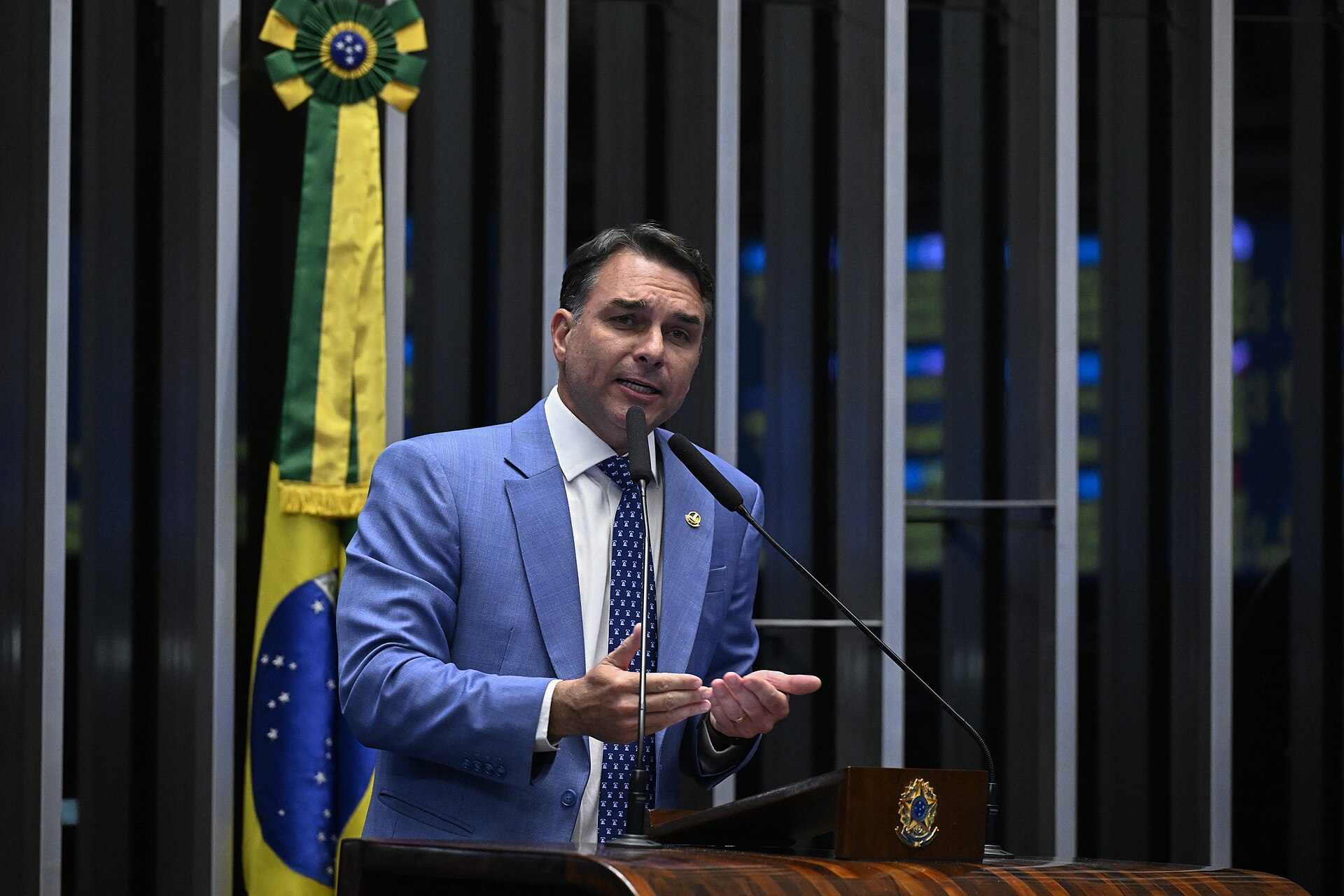

Justice Alexandre de Moraes ordered Senator Flávio Bolsonaro summoned by public notice over a post criticizing Lula, saying he is in an unknown location in the United States while citing his interviews there, and again skipped the formal request to U.S. authorities.
BRASILIA — Justice Alexandre de Moraes of Brazil’s Supreme Court has ordered that Senator Flávio Bolsonaro be summoned by public notice, a notice printed in the court’s official gazette, to answer a criminal complaint that he slandered President Lula. In the order, signed on Friday, Nov. 20, and first detailed by Gazeta do Povo, Moraes wrote that Flávio is in the United States “in an uncertain and unknown location,” and once again chose not to use the formal legal-cooperation request to American authorities that Brazilian law provides for defendants abroad.
The same order notes that Flávio, the opposition candidate defeated in the October runoff that Lula “won,” has given several interviews from the United States, including one to The New York Times published on Nov. 5. The court knows the country, follows the interviews, and still describes the whereabouts as unknown. Flávio now has 15 days, counted from the first business day after the notice is published, to respond. After that, Moraes’s First Panel decides whether to make him a defendant.
The case behind the summons
The complaint, filed by the Prosecutor General’s Office on Nov. 18, rests on a single post on X from Jan. 3, 2026. Flávio paired images of Lula and Venezuela’s Nicolás Maduro and wrote that Lula would be named by informants, listing drug and arms trafficking, money laundering and support for terrorists and dictatorships. The Federal Police opened the inquiry in April and sent its final report in June. Prosecutors argue the post fell outside parliamentary immunity because it was published on a personal account. In other words, a sitting senator and presidential candidate faces criminal charges for criticizing the head of state, in the same year he ran against him.
The timeline matters. On Oct. 25, minutes after polls closed, Moraes ordered Flávio’s passports seized in a separate money-laundering probe tied to illegal betting, which Flávio denies. Two days later, on the night of Oct. 27, the senator crossed the bridge from Foz do Iguaçu into Argentina and flew to the United States. Moraes now calls him a fugitive. The Federal Police itself said in an Oct. 28 note that travel-document restrictions “by themselves do not characterize the condition of fugitive.” There is no arrest warrant against him.
Why it matters
Brazil’s Code of Criminal Procedure says that when a defendant is abroad at a known location, the court should use a letter rogatory, a formal request that a foreign government serve the papers. Skipping it means the case can move forward without the defendant ever being formally served in the country where he lives. For American readers, this is a case in which a Brazilian court is prosecuting a political figure on U.S. soil over speech, while declining to route the process through U.S. authorities. As we reported, Democrats in Congress have already made Flávio’s presence in the United States a political issue in Washington.
The record
The public-notice route is now a pattern with Moraes’s critics abroad, according to Gazeta do Povo. Former electoral-court adviser Eduardo Tagliaferro, who lives in Italy, was summoned by notice, and his private lawyers were later removed from the case. Eduardo Bolsonaro was summoned the same way, and a public defender was assigned when he did not respond. Commentator Paulo Figueiredo never formally entered his case. Journalist Oswaldo Eustáquio was summoned by notice in August even though, his lawyer says, Brazil knew his address in Spain because it had requested his extradition. What is established is the content of the orders. Whether each case meets the legal threshold for a public notice is what the defense lawyers dispute.
The pattern fits a court that, as we have documented, concentrates a large share of its criminal docket in one justice’s hands, and that has voted to try an opposition lawmaker for criticism. Under the Lula regime, the defeated candidate is charged for a post, declared a fugitive without a warrant, and served through a gazette instead of the legal channel with the country where he openly lives. The next step is predictable: the 15 days run out, the panel receives the complaint, and the trial goes on without him.
The Watch Post Daily will continue to follow this story. Sources: Gazeta do Povo, Estadão (Blog do Fausto Macedo), g1, Federal Police note of Oct. 28, 2026.
Featured image: Plenário do Senado – 55502941346 by Agência Senado, via Wikimedia Commons, CC BY-SA 4.0.

COMMENTS