
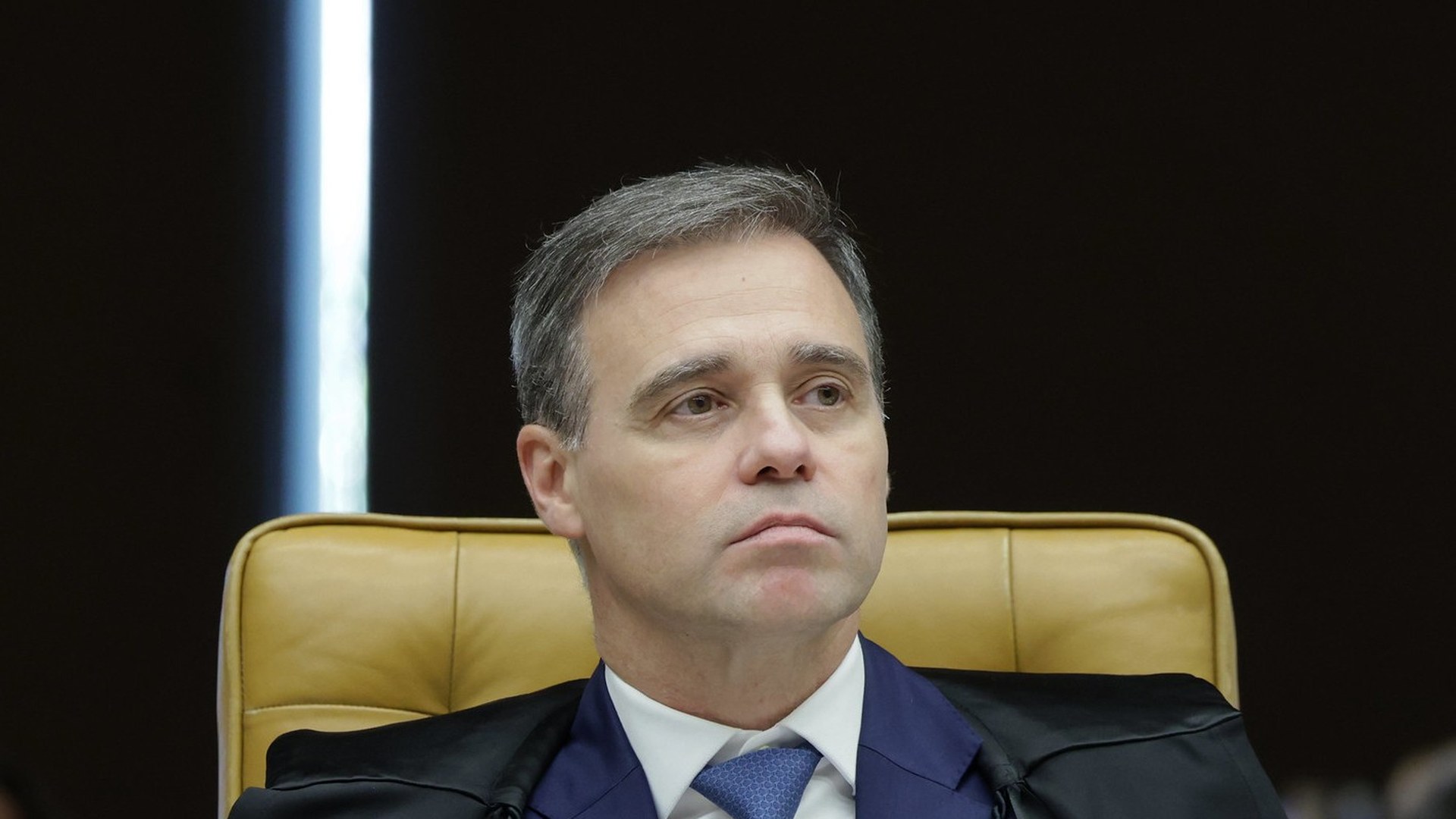

Justice André Mendonça asked the Attorney General’s Office for an opinion on an urgent request to cut the 14-year sentence of a Jan. 8 convict under the Dosimetry Law, which Justice Alexandre de Moraes has kept from applying to these cases since May.
BRASILIA — Supreme Court Justice André Mendonça on Wednesday asked the Attorney General’s Office (PGR) for an opinion on an urgent request to cut the sentence of a woman convicted over the Jan. 8, 2023 riots, according to reports by Brasil em Folhas and Revista Oeste. The request comes from the Federal Public Defender’s Office (DPU), which wants the justice to apply the Dosimetry Law to her case, the same law that Justice Alexandre de Moraes has kept from taking effect in Jan. 8 sentence-execution cases since May.
The convict is a 45-year-old waitress sentenced to 14 years in prison. She has been held since July 17 at the state penitentiary in Bento Gonçalves, in Rio Grande do Sul. By the DPU’s calculation, applying the law would bring her sentence down to six years, five months and ten days. The defenders argue that she did not lead or finance the events, the two conditions that allow a reduction for people who took part in a crowd. They also ask for her acquittal, saying there was no individual proof that she used violence or knowingly joined the crimes. In her interrogation, according to the report, she said she meant to stay on the lawn of the Esplanada to sing and pray, and that she went into the Supreme Court building out of fear of rubber bullets after being hit by gas and pepper spray.
Why it matters
The case is a small test of a large question: can a single justice keep a law from applying when Congress passed it over a presidential veto and the full court has not ruled? That is a question about the rule of law in the hemisphere’s second-largest democracy, and American readers who follow how Washington deals with Brasília should know where the answer stands.
A law frozen for six months
Congress overrode President Lula’s veto on April 30, and Senate President Davi Alcolumbre promulgated Law 15.402/2026 on May 8. The next day Moraes suspended its application to Jan. 8 execution cases, saying the court should first decide the challenges filed by the Brazilian Press Association (ABI), the PSOL-Rede federation, the PDT and the PT-PCdoB-PV federation. The Chamber of Deputies and the Senate told the court the law is valid. The attorney general, Paulo Gonet, told Moraes in June that he opposed an immediate suspension, as reported by Gazeta do Povo and Jovem Pan. The DPU now argues that suspending a federal law normally requires a majority of the full court, which has not voted.
The DPU says it first asked for the law to be applied on July 17, repeated the request on July 24, and pressed for a decision on Sept. 14. On Sept. 1, Moraes denied her house arrest, arguing that the prison can provide care. The DPU cites medical records showing bipolar disorder and two suicide attempts since 2023, and a prison health unit report dated Aug. 18 that recommended monitoring because of the risk of suicidal behavior. It now asks Mendonça to suspend the execution of the sentence and release her until a criminal review is judged, or, at minimum, to move her to house arrest. The same pattern of discretionary calls was on display in how Moraes decides who wears the ankle monitor, and in the 431 convicts who remain in prison.
There may be movement. BH 24 Horas reported that Moraes told Deputy Paulinho da Força (Solidariedade), who was the Chamber’s rapporteur on the law, that the court could soon return to the cases on the dosimetry of Jan. 8 sentences. It is the deputy’s own assessment that the subject, stalled for about six months, could come back in November, possibly next week.
The record
Confirmed in the reports: Mendonça asked the PGR for an opinion on Nov. 11; Moraes denied house arrest on Sept. 1; the law was promulgated on May 8 and suspended by Moraes in Jan. 8 execution cases. Alleged: the DPU’s calculation of six years, five months and ten days, its claim that she did not lead or finance the events, and the medical history it cites. Not yet known: whether the PGR will support the request, and what Mendonça will decide.
The law was approved by both chambers, survived a presidential veto, and has been on ice for six months because of one justice’s order, while a woman with a documented history of suicide attempts waits in a state prison for someone to decide. That is not a technical delay. It is a Judiciary that gets to decide whether the Legislature’s work exists, and it does so under a regime whose 2022 victory millions of Brazilians still dispute. The next test is the PGR’s opinion and whether Mendonça acts before the full court finally sits.
The Watch Post Daily will continue to follow this story. Sources: Revista Oeste, Brasil em Folhas, Marreta Urgente, BH 24 Horas, Gazeta do Povo and Jovem Pan.
Featured image: Ministro André Mendonça em outubro de 2025 by Rosinei Coutinho/STF, via Wikimedia Commons, Attribution license.

COMMENTS