
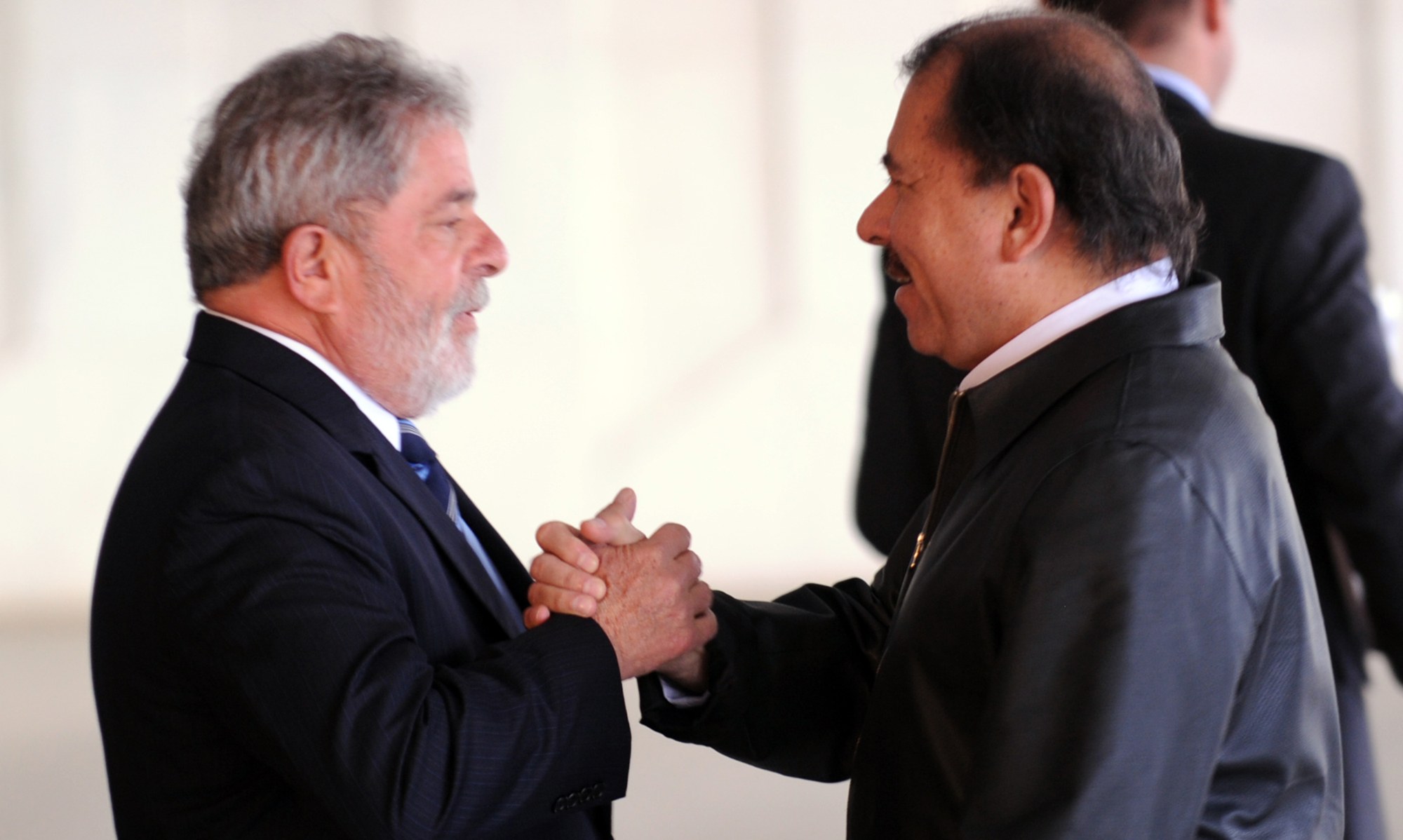

Daniel Ortega told a Sandinista rally that Nicaragua will never hold another election, four months before the general vote already on the calendar for November 2026. Brazil's president has called him “my friend Daniel” since 2007 and declined to condemn him when his rivals were jailed.
MANAGUA — Daniel Ortega told a Sandinista rally on Sunday, July 19, that Nicaragua will never hold another national vote. “There will be no elections here again,” the 80-year-old former guerrilla said at the 47th anniversary of the revolution that first carried him to power, so that the opposition cannot “try to grab the government that way.” He added that he would work with the National Assembly, which his party controls, on legislation raising new barriers to opposition parties in any future ballot.
Nicaraguans were supposed to be voting this month. General elections were on the calendar for November 2026. There is no ballot, no date and no candidate — and the man who has called Ortega “my friend Daniel” since 2007 now presides over Brazil’s own disputed vote count.
How the ballot disappeared
The vote vanished in two steps. In January 2025 the Ortega-controlled Congress extended the presidential term from five years to six, moving the election from November 2026 to November 2027. A constitutional reform that took effect in February 2025 then stripped the branches of government of their independence and elevated Ortega’s wife, Rosario Murillo, from vice president to co-president, a title no Nicaraguan had held before. In July, Ortega removed the remaining date altogether.
Nothing about the sequence was improvised. Nicaragua has been in open crisis since the street uprisings of April 2018 were crushed. Before the 2021 election, the government jailed or disqualified the leading opposition candidates, and Ortega took a fourth consecutive term with no competitor on the ballot. In February 2023 the regime flew 222 political prisoners to the United States and stripped them of their nationality; more than 300 dissidents in total were denationalized, their property seized.
Juan Sebastián Chamorro, one of the exiles who lost his citizenship and his assets, said Ortega “has taken off one more mask — the one that hid that he does not want elections to return to Nicaragua under any circumstance.” The Inter-American Commission on Human Rights repudiated both the statement and the plan to write opposition parties out of the law.
Why it matters in Washington
Nicaragua is the finished version of a process the hemisphere keeps watching in progress. The ballot was the last thing to go, not the first. The courts went first, then the prisons, then the passports — and by the time the president said the sentence out loud, there was nobody left inside the country with standing to answer him. That order of operations is the part worth exporting, and it is the part Brazilian institutions have been testing for three years.
Lula’s forty-year friendship
The record of Brazil’s president on Ortega is long and dated. In August 2007, on an official visit to Managua, Luiz Inácio Lula da Silva called him “my friend Daniel Ortega” and praised the work Ortega had done “to consolidate Nicaragua as a sovereign country.” Ortega returned the visit on July 28, 2010, received at a lunch at the Itamaraty Palace. In November 2021, asked about the opposition candidates Ortega had imprisoned before that year’s vote, Lula declined to condemn him, saying he could not judge the reasons for the arrests. His party, the PT, published a note saluting Ortega’s re-election and deleted it after the backlash. In the October 28, 2022 runoff debate, Lula said he was “proud to have taken part in the celebration of the Sandinista Revolution.” In March 2023, when 55 countries signed a joint declaration at the UN Human Rights Council condemning Nicaragua’s abuses, Brazil stayed off the text and offered dialogue instead.
The record
What is documented is the quote, the constitutional reform, the dated statements above, and the 2023 abstention. The other half of the record belongs in the same paragraph: Brazil did criticize the mass denationalization of Nicaraguan dissidents, later presented its own critical document at the UN, and in August 2024 expelled Nicaragua’s ambassador after Ortega expelled Brazil’s chargé d’affaires, Breno de Souza. No Brazilian decree cancels an election, and nobody in Brasília has said what Ortega said in July. What exists in Brazil is not a declaration. It is a pattern.
That pattern is on this site’s record: a Supreme Court justice toasting Lula’s re-election with the senator who decides whether he faces impeachment, a presidential count that delivered for the ruling party in seven states where its own party elected no federal deputy at all, and three southern states where citizens are already voting on leaving the union because they no longer expect the national ballot to count. Nicaragua did not abolish elections in a speech. It abolished them over eighteen years, and the speech came last.
Sources: Telemundo/EFE, Associated Press, MercoPress, the Inter-American Commission on Human Rights, Gazeta do Povo, O Povo. The Watch Post Daily will continue to follow this story.
Featured image: Lula greets Daniel Ortega at the Itamaraty Palace, July 28, 2010 by Roosewelt Pinheiro/ABr, via Wikimedia Commons, CC BY 3.0 BR.

COMMENTS