
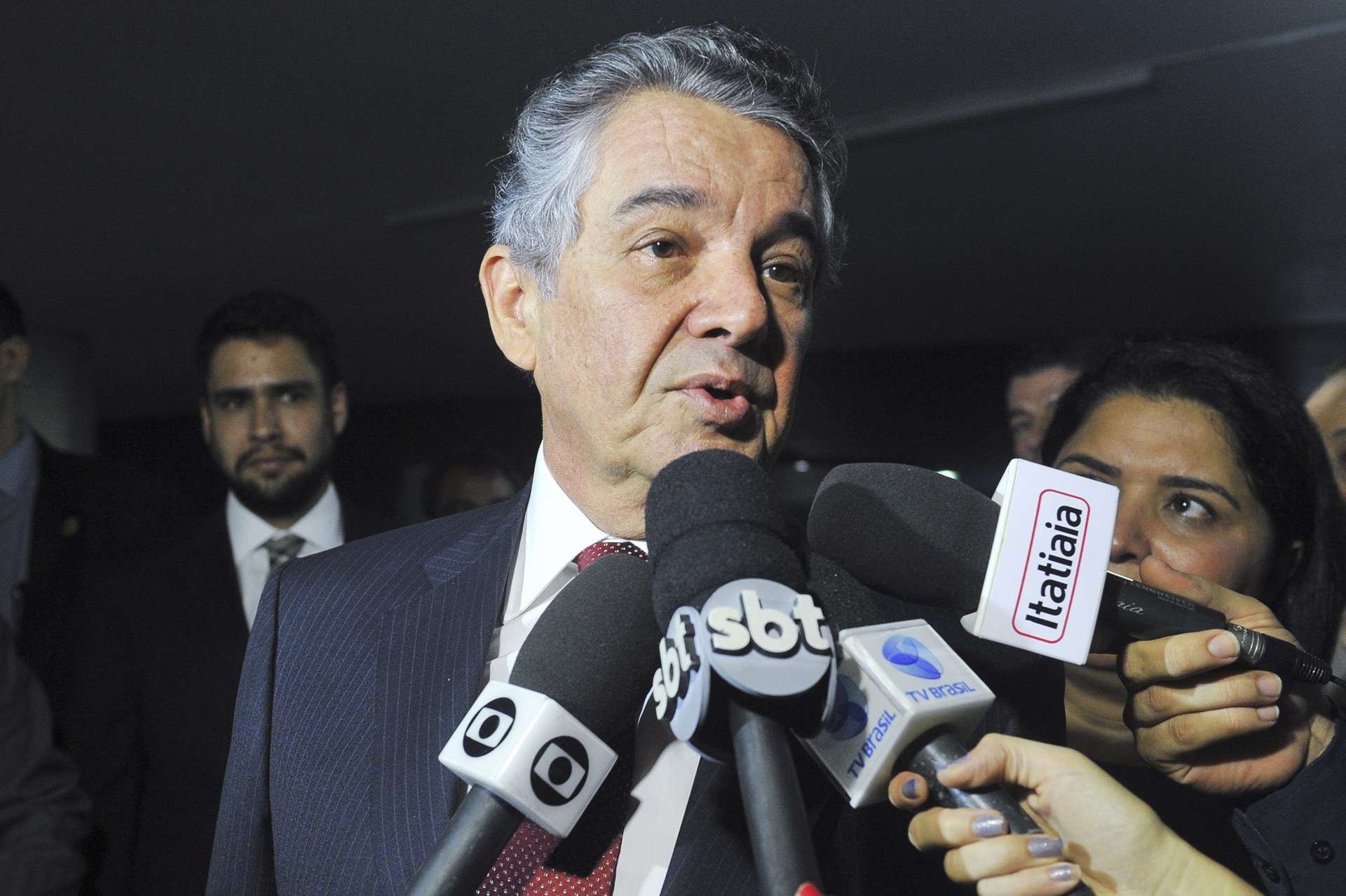

Marco Aurelio Mello, who sat on Brazil's Supreme Court for 31 years, told Radio Bandeirantes that Flavio Bolsonaro's departure for the United States was an act of self-defense against an expected arrest, and accused Justice Alexandre de Moraes of overreach.
SAO PAULO — Marco Aurelio Mello, a retired justice who spent 31 years on Brazil’s Supreme Federal Court (STF), said on Oct. 30 that Flavio Bolsonaro’s departure from Brazil was an act of self-defense against a likely arrest, not an escape from justice. Speaking to journalists Marco Antonio Sabino and Paula Valdez on Radio Bandeirantes in Sao Paulo, he said the order to surrender Flavio’s passports came with no criminal investigation open against him, and that Justice Alexandre de Moraes “has been going too far.” The full transcript was published by Porto Alegre journalist Polibio Braga.
Flavio Bolsonaro, the senator and son of former president Jair Bolsonaro, lost the October runoff to Luiz Inacio Lula da Silva. Within the hour, Moraes ordered him to hand over his passports, a move made without a criminal charge. Flavio then left for the United States with his wife and two daughters, and has spoken from American soil about why he went.
Who Marco Aurelio Mello is
For foreign readers, the name carries weight. Marco Aurelio Mello joined the STF in 1990 and stayed until his mandatory retirement in July 2021, after 43 years as a judge on collegiate courts. He presided over both the Supreme Court and the Superior Electoral Court (TSE), and he was known for decades as the court’s most persistent dissenter, a justice who often voted alone in defense of procedure and individual rights. He was appointed long before Jair Bolsonaro entered national politics. He is not a Bolsonaro ally. He is a guardian of the old constitutional rulebook, and that is exactly why his reading of the case matters.
What he said
“We live in strange times,” Mello said. He noted reports, which he said he had not confirmed, that the passport order was in the court system seven minutes after the polls closed. “Surrendering passports restricts the freedom to come and go, there is no doubt about it. And there are, so far, no investigations under way. It would be a hasty measure.” Flavio, he said, “presumed that after this surrender there would inevitably be an order of preventive arrest,” and acted to protect “that greater right, after the right to life, which is the right to come and go.”
Asked whether Moraes was abusing his power by relying on a video in which Eduardo Bolsonaro said his brother would leave Brazil if he lost, Mello pointed to a double standard. “Two weights and two measures in the judiciary is terrible,” he said, citing Lula’s own son, who remains in Spain while investigations close in at home. He also said the STF has stretched its criminal jurisdiction to try ordinary citizens and former officials, something his court used to send down to lower courts. “No body sits above it to review its decisions,” he said.
Why it matters
When a retired justice of Brazil’s highest court, with no political debt to the right, describes the country’s leading opposition figure as acting in self-defense, the question is no longer partisan. It is about whether the opposition in the hemisphere’s second-largest democracy can stay in the country without risking prison. For Washington, Flavio’s presence in the U.S. turns that question into a bilateral one.
The record
Confirmed: the passport order, issued in the hours after the runoff without an open criminal case; Flavio’s departure to the United States; Mello’s statements, on the record, on Radio Bandeirantes. Reported but unconfirmed, by Mello’s own account: the seven-minute timing. Mello’s view that an arrest would have followed is his legal assessment, not a court finding.
The Lula regime came to power in a 2022 election that millions of Brazilians still dispute, and it now governs alongside a court that rules without appeal. Mello’s warning is that, in such times, “anything can happen.” The pattern points one way: opponents lose their passports first and their freedom next, while allies are left alone abroad. Unless something changes, it will get worse, not better.
The Watch Post Daily will continue to follow this story. Sources: interview of Marco Aurelio Mello to Radio Bandeirantes, Oct. 30, 2026; full transcript published by Polibio Braga.
Featured image: Entrevistas Diversas (24987375674) by Jane de Araujo/Agencia Senado, via Wikimedia Commons, CC BY 2.0.

COMMENTS