
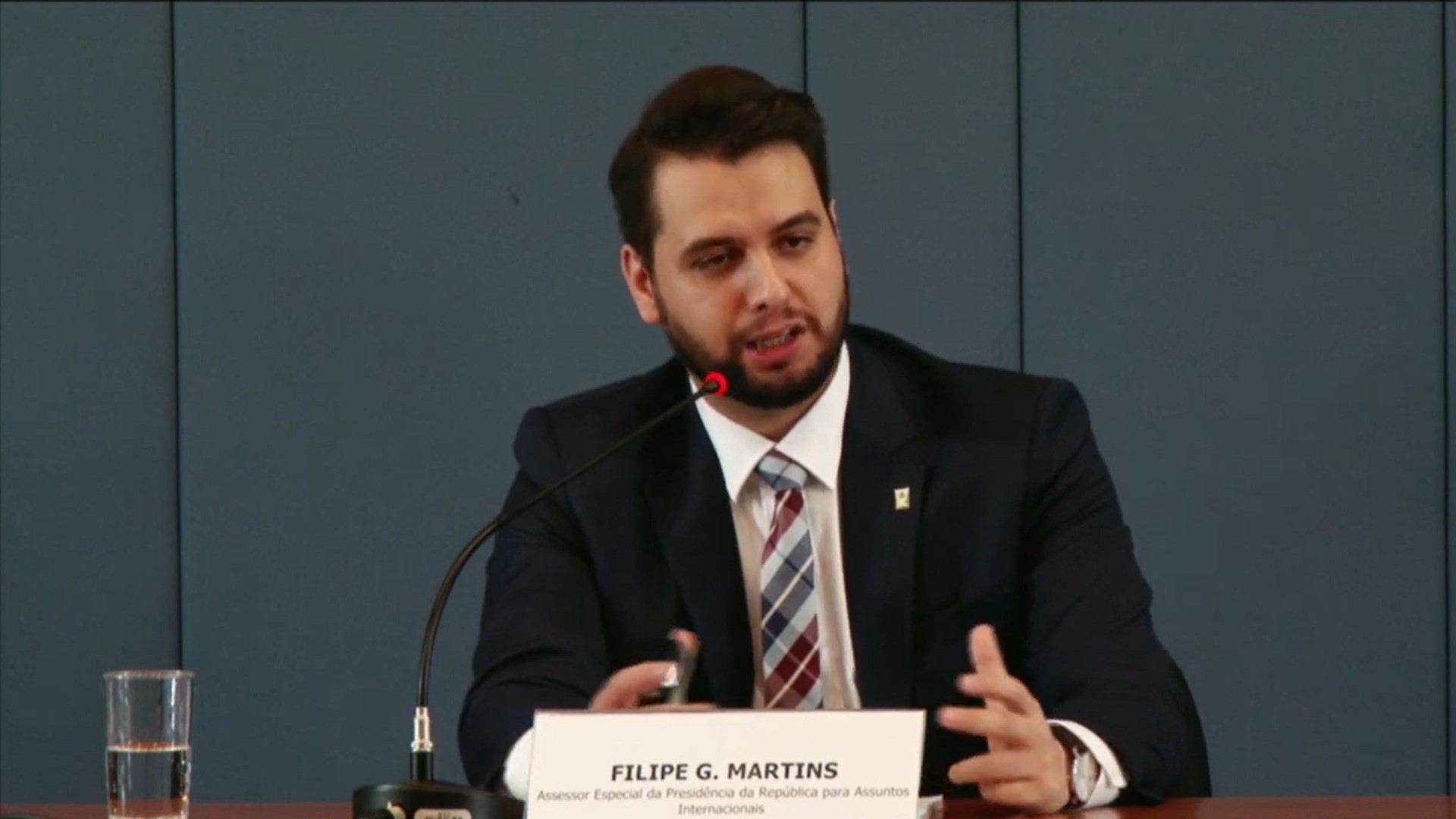

Filipe Martins, Bolsonaro's former foreign policy adviser, passed 1,000 days in custody on Nov. 6. His lawyer says the case still leans on a U.S. entry record that a federal judge in Florida has called false, while a 21-year sentence keeps him in a cell in Paraná.
BRASILIA — Filipe Martins, the former international affairs adviser to Jair Bolsonaro, passed 1,000 days in custody on Nov. 6, counted from his first arrest in February 2024, and his lawyer says the case that put him there still leans on a U.S. immigration record that a federal judge in Florida has called false. In an interview with Ricardo Scheiffer, reported by Revista Oeste, the defense described a prisoner held in isolation in Ponta Grossa, in the state of Paraná, far from his young daughter and with no release date, serving a 21-year sentence handed down by the Supreme Court in the case known as the “coup plot.”
A flight from Brasília to Curitiba, a phone’s location history and a pile of app receipts put him in Brazil on Dec. 31, 2022. One line in a U.S. border database put him in Orlando the day before. A federal judge says that line is false. Martins has now spent 1,000 days behind bars, and nobody has yet said who typed it in.
The defense says the cell has become a study room. Martins keeps a strict routine of prayer, exercise and reading, about ten books a month, and is studying Latin, Greek and Arabic alongside philosophy, history and geopolitics. His lawyer says none of that changes the central fact: he is serving a sentence for a conviction that, in the defense’s words, lacks consistent proof.
The record at the center of the case
Martins was first jailed in February 2024, in the operation known as Tempus Veritatis, after investigators pointed to a supposed trip to the United States on Dec. 30, 2022, as a sign that he had left the country with Bolsonaro. The defense produced a Latam flight from Brasília to Curitiba on Dec. 31, the phone’s geolocation data and app receipts placing him in Brazil. It also pointed to the U.S. border record itself: the first name was misspelled “Felipe,” the passport had been canceled since 2021 and the visa category did not fit.
His lawyers then sued the Department of Homeland Security and Customs and Border Protection in Florida in January 2025, under the U.S. Freedom of Information Act. At a hearing in that case, Judge Gregory Presnell recognized that the information was false and the harm it caused Martins, put off the government’s request to end the suit and ordered the material filed under seal so he could review it himself. A government lawyer told the court that how the data entered CBP’s systems is under investigation. The defense also says Brazil’s Prosecutor General’s Office had already acknowledged there was not enough evidence that Martins had left the country.
Why it matters
For American readers, the question is not only Brazilian. A record in Washington’s own border system was used to jail a man in the largest democracy in South America, and a U.S. judge is now asking how it got there. Whoever answers that question will say something about how far a court in Brasília can reach with a foreign agency’s data, and who checks it.
The record
Established: the Supreme Court’s First Panel convicted Martins to 21 years in December 2025 in the coup plot case; he reached 1,000 days of custody on Nov. 6, counted from February 2024; and Judge Presnell said, in open court, that the U.S. entry record is false. Still an allegation: the details of his isolation and routine come from his lawyer; the claim that the conviction rests on a plea deal by Mauro Cid and documents whose authorship was never proven is the defense’s argument; and no one has been named as responsible for the false entry. The investigation inside CBP is ongoing.
A court that jails a man on an entry record the United States itself disowns, then sentences him to 21 years on the word of a cooperating witness and papers nobody has traced to him, owes the public an answer. A thousand days is a long time to wait for one, and the same Supreme Court that was warned this week a January 8 political prisoner could die in custody still runs 97% of its criminal docket through one chamber.
The Watch Post Daily will continue to follow this story. Sources: Revista Oeste (interview with attorney Ricardo Scheiffer, Nov. 10), Brazilian press coverage of the hearing before Judge Gregory Presnell, and the Supreme Court’s First Panel judgment of December 2025.
Featured image: Filipe Garcia Martins in May 2019 by Brazil’s Ministry of Foreign Affairs, via Wikimedia Commons, CC BY 3.0.

COMMENTS