

Lula mocked the 14 countries in Trump’s Shield of the Americas, and four days later Brazil voted with only Uruguay against a U.S.-backed OAS resolution on drug trafficking. Its stated fear: sanctions that would make banks refuse payments.
BRASILIA — The Lula regime has now turned down Washington’s hemispheric campaign against organized crime twice in one week: once in words and once with a vote. In a conversation with Spanish Prime Minister Pedro Sánchez, recorded in Madrid on Nov. 16, Lula mocked the 14 governments that joined President Donald Trump’s Shield of the Americas. “To follow whose political and ideological line? Trump’s,” he said, according to Gazeta do Povo. “No, that way it’s not possible.” Four days later, on Nov. 20, Brazil voted against a U.S.-backed resolution on drug trafficking at the Organization of American States, joined only by Uruguay.
The Shield of the Americas was launched by Trump and Secretary of State Marco Rubio in March, at Doral, Florida, to coordinate the fight against cartels and transnational trafficking. Argentina, Paraguay, Chile, Peru and other neighbors of Brazil signed on. In September, at a meeting held alongside the UN General Assembly, the members announced sanctions against 24 criminal organizations, according to Brasil Paralelo, including Brazil’s two largest factions, the PCC (First Command of the Capital) and the Comando Vermelho (Red Command). Washington had already designated both as terrorist organizations. The Lula regime rejects that label.
Why it matters
The PCC and the Comando Vermelho are not a local problem. They move cocaine to Europe and Africa, launder money through legitimate businesses and operate across South America’s borders. The OAS resolution, approved 14 to 2 with the Bahamas abstaining, calls a meeting of foreign ministers under the 1947 Inter-American Treaty of Reciprocal Assistance, known as TIAR, no later than early February. The U.S. representative told the council the meeting is not “a prelude to military action” and that the goal is to hit the factions financially, Brasil Paralelo reported. For Americans, this means the largest country in South America has placed itself outside the regional effort against the groups Washington classifies as terrorists, as we reported after the vote.
Brazil’s reasons, as stated at the OAS, are revealing. Its ambassador said Brazil also wants to fight the factions but fears the use of force could return to the table. He also warned that the treaty allows cutting economic ties, so that “banks could refuse payments and credit for fear of noncompliance,” hitting companies unrelated to crime. Brazilian diplomats fear the terrorist designation could open the door to direct U.S. military action on Brazilian soil, according to Gazeta do Povo. The objection, in short, is not to the target. It is to the tools that work: following the money.
The record
What is established: Lula’s words to Sánchez, published by the Spanish prime minister and reported by Gazeta do Povo; the Nov. 20 vote count; and the September sanctions list. The OAS text authorizes no military operation. Brazilian officials and some prosecutors argue the country already has the legal tools it needs. São Paulo prosecutor Celeste Leite dos Santos told Gazeta do Povo that Brazil’s new anti-faction law, Law 15,358 of 2026, carries tougher penalties than a terrorism label would. Uruguay’s ambassador, Edison Lanza, said the gravity of the crime does not justify treating criminals as terrorists.
But the money is the point. In August 2025, Operation Carbono Oculto, run by São Paulo prosecutors and the federal tax service, targeted what investigators described as a PCC scheme laundering money through fuel distributors and fintech firms in the country’s financial center. A regime that worries out loud about banks refusing payments is describing the pressure that criminal finance fears most. Lula, who was “re-elected” in October, will not take Brazil into the Shield. When the foreign ministers meet in February, Brazil will be sitting across the table from its own neighbors, defending the line Lula drew in Madrid.
The Watch Post Daily will continue to follow this story. Sources: Gazeta do Povo, Brasil Paralelo, Organization of American States.
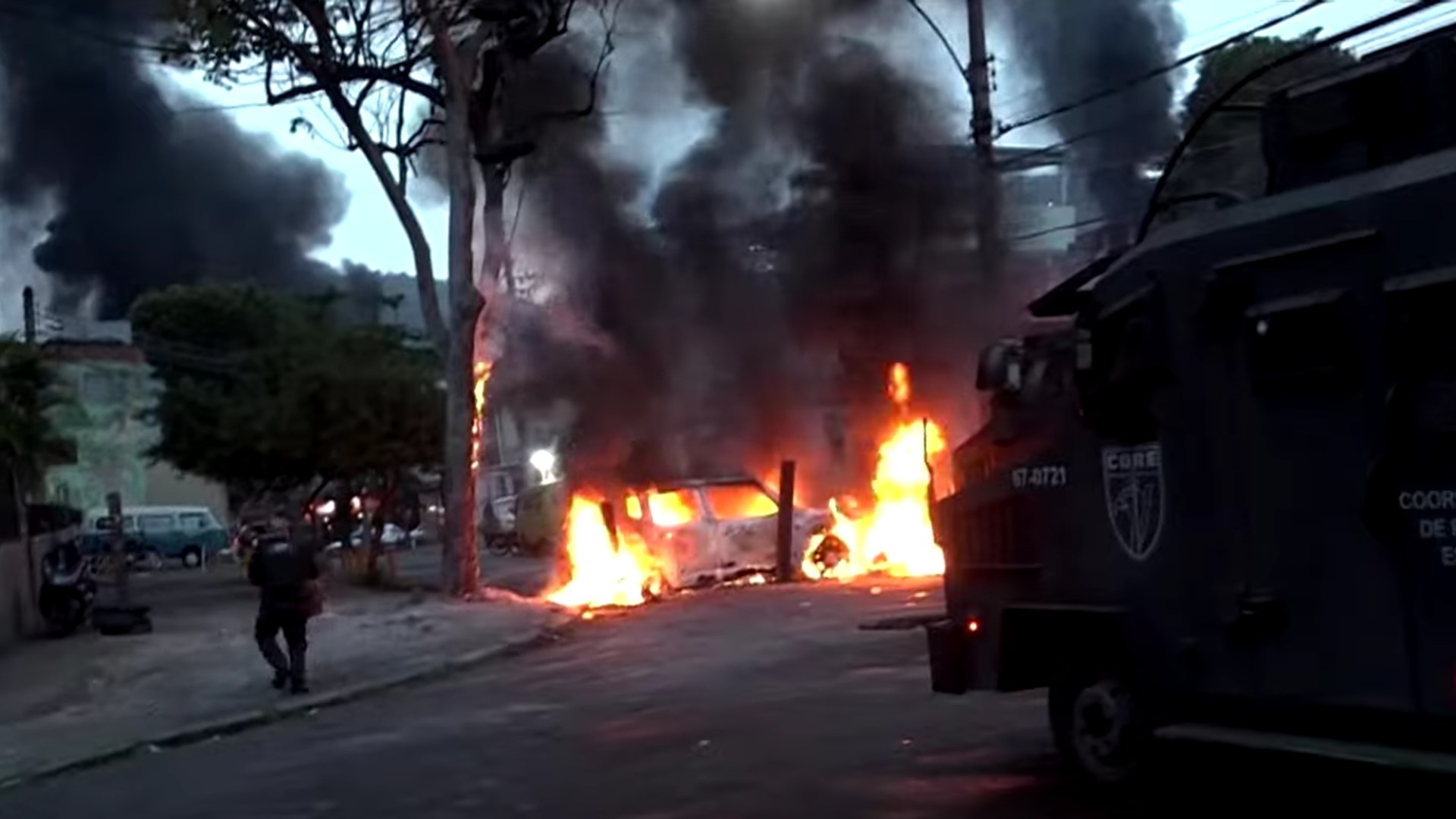
Featured image: Operação Contenção com veículo blindado do CORE e ao fundo uma barricada com veículo em chamas (police operation against the Comando Vermelho in Rio de Janeiro, Oct. 2025) by CanalGov, via Wikimedia Commons, CC BY 3.0, cropped.

COMMENTS