

Brazil's Supreme Court unanimously refused to lift the arrest warrant against Eduardo Bolsonaro, the former congressman living in the U.S. since 2025 and sentenced to four years and two months for lobbying Washington during his father's trial. The defense's arguments were never heard on the merits.
BRASILIA — Brazil’s Supreme Federal Court has unanimously refused to lift the arrest warrant against Eduardo Bolsonaro, the former congressman and son of ex-president Jair Bolsonaro who has lived in the United States since 2025. The court’s Second Panel closed a virtual session on Nov. 10 with all five justices, including the two appointed by Jair Bolsonaro, backing rapporteur Dias Toffoli, according to Jovem Pan. The ruling keeps in force a sentence of four years and two months for what Brazilian law calls “coercion in the course of proceedings.”
Federal prosecutors charged that he lobbied the U.S. government for sanctions and tariffs against Brazil and against Supreme Court justices in order to pressure the court during his father’s coup trial, which ended in a 27-year sentence. The First Panel, led by Justice Alexandre de Moraes as rapporteur, convicted Eduardo in June, rejected his appeal unanimously on Sept. 18, and declared the ruling final on Oct. 3. Five days later, Moraes ordered the sentence carried out, issued the arrest warrant, cancelled every Brazilian passport in Eduardo’s name and suspended his political rights. During the vote, Moraes said it is “not the role of a Brazilian federal deputy to lobby abroad against his own country.”
Why it matters
The conduct that put Eduardo on Brazil’s national arrest registry took place largely on American soil and consisted of meetings with American officials. A Brazilian court has turned political advocacy before a foreign government into a criminal offense, and the man convicted for it lives a few hours from Washington. That raises direct questions for the United States about extradition requests, Interpol notices and the safety of dissidents who seek refuge here. It lands while the Lula regime and Washington are already at odds, as Marco Rubio made clear this week.
A defense that was never heard
The panel did not rule on guilt, only on whether his lawyers could be heard. On Oct. 13, Toffoli refused to take up habeas corpus petition 278370 on his own, citing by analogy a court precedent that bars habeas corpus against decisions of the court’s own panels, while noting his personal disagreement with that rule. The defense had argued that the conviction became final too early, that Eduardo was jailed before his appeals ran out, that he was never properly served with notice while living abroad, and that the trial carried the marks of a political judgment. It asked for review by the full court without Moraes, who, the public defender argued earlier, was himself a target of the U.S. sanctions at the center of the case. None of those points was examined on the merits.
The pattern is familiar to anyone who has followed Brazil since 2022. The same justice is the alleged victim, the investigator and the rapporteur, and every route to review closes on a technicality. It happens under a government whose 2022 victory remains disputed by millions of Brazilians who allege electronic ballot fraud, and while the opposition looks abroad for relief, as the Liberal Party’s planned complaint to the OAS shows.
The record
Confirmed in court records: the conviction, the finality, Moraes’s Oct. 8 orders and the Nov. 10 vote. Alleged by the defense and by critics of the court: that the trial was political, that service of process was defective, and that Moraes should not have judged a case in which he was a party. Eduardo has called the warrant arbitrary.
The ruling leaves Eduardo with no passport, no political rights and no open door at the Supreme Court. With remedies in Brazil effectively exhausted, the question moves to Washington: if Brasília seeks extradition or an Interpol red notice, American authorities will have to decide whether lobbying the U.S. government counts as a crime they are willing to help punish. With impeachment requests against the justices piling up in the Senate, critics see one more sign that the justices answer to no one.
The Watch Post Daily will continue to follow this story. Sources: Jovem Pan; SBT News; STF habeas corpus 278370 (Toffoli decision of Oct. 13, 2026); STF criminal action 2782.
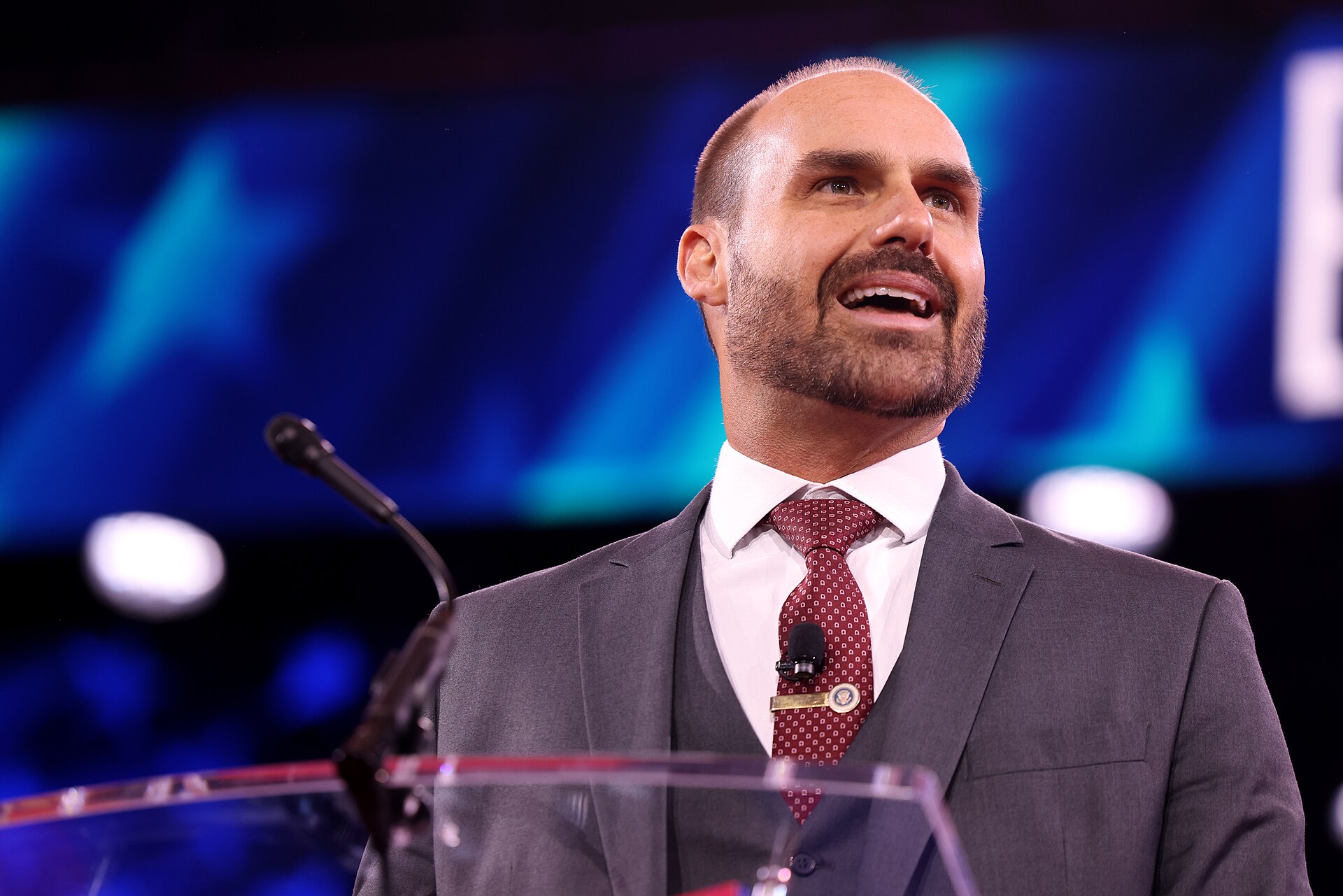
Featured image: Eduardo Bolsonaro (54346293802).jpg by Gage Skidmore, via Wikimedia Commons, CC BY-SA 2.0.

COMMENTS